About the Project

John W. Wallace, MA Student in Public History, Project Creator, 2025. Photograph by author.

Project Background

Death in Transition was researched and created by John W. Wallace, a Master's student in Public History, with a concentration in museum management. The project was the capstone project for Digital Tools for Historians (HIST 6450), taught by Dr. Andrew Maginn in the Fall 2025 semester. The purpose of this project is to demonstrate proficiency in the digital tools and research methods covered in the course.

Originally, I conceptualised this project as an interactive Neatline digital map that visualised the reach of geographic influence of multiple East Tennessee funeral homes, based primarily on TSLA funeral home records. While this aspect did become a scaled-down section of the project under "Access, Adoption, and Hesitation," the project I initially wanted would require more time and technical skills in ArcGIS that fell outside the scope of the course. I shifted instead to create a more narrative-focused digital exhibit that showcases topics tied to the research for my master's thesis, Crafting the “Appalachia Way of Death” Artisan Undertaking, Commercial Deathcare, and the Interpreting Deathcare in East Tennessee, 1870–1929. Pulling from Newspaper articles and advertisements, census records, photographs, and trade magazines, I produced an exhibit that highlights the development of the commercial funerary industry in East Tennessee. 

Exhibit Methodology 

The narratives and information presented in this exhibit are based on the preliminary research I conducted to prepare my thesis proposal during the Summer and Fall of 2025. Because I aimed to create a publicly accessible form of my thesis topic, I chose to simplify my research into key interpretive themes and focus on those, rather than presenting overly academic arguments. Additionally, I actively sought to highlight urban and African American experiences, as these perspectives have historically been silenced in both the archives and Appalachian scholarship.

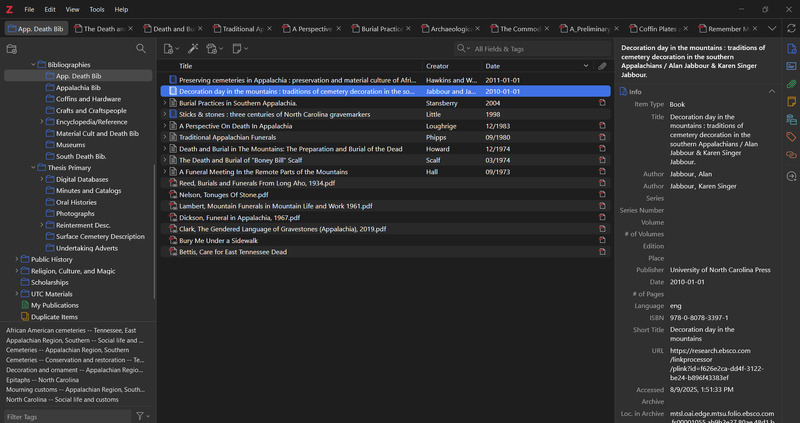
A screenshot of the "App. Death Bib" folder in the research management software, Zotero. With Zotero, Wallace organized secondary scholarship based on which historiography they were most relevant to. For multi-historiography works, such as Jabbours' Decoration Day in the Mountains, the work is linked in multiple folders. Screenshot by author, 2025.

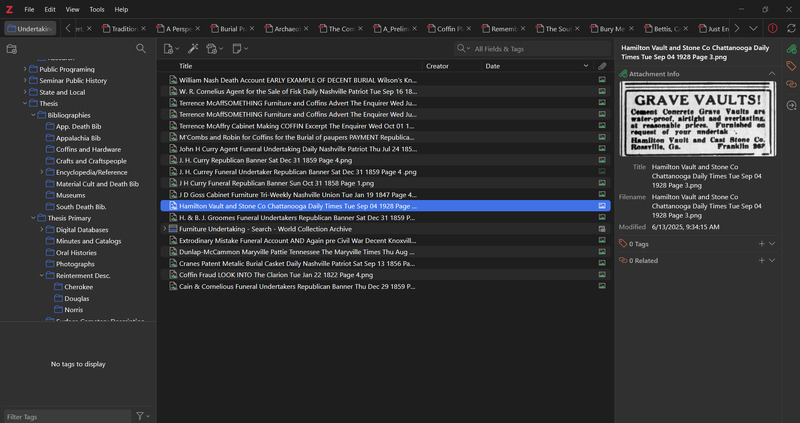
A screenshot of the "Undertaking Adverts" folder in the research management software, Zotero. Wallace also used Zotero to organize his primary sources. Screenshot by author, 2025.

Given the preliminary stage of my research and the limited scope of a course project, many of the arguments presented in Artisan Undertakers, Growing Industry, and the Development Timeline drew primarily on Southern and Southern Appalachian secondary scholarship, while also incorporating East Tennessee–specific primary sources and local stories. To accomplish this, I primarily relied on public and government records accessed through Ancestry.com, as well as historical articles and advertisements located via Newspapers.com, to gather information about selected undertaking professionals and businesses. I also surveyed current East Tennessee funeral home websites to identify existing corporate histories, which served as starting points for further research into the development of these businesses.

New Goods and Services, due to the time period examined, relied more on broader national sources, since many products had become widely distributed through trade magazines across the 20th century, and thus broadly represent what East Tennesseans, especially in urban areas, likely had access to in the early 20th century. Inversely, Access and Adoption was nearly entirely focused on East Tennessee, due to focusing entirely on localized funeral home records. 

Because I drew from a wide variety of historiographies and source types, I used Zotero to organize both scholarship and primary sources. I categorized the scholarship by historiographic theme, with sections such as Coffins and Hardware and Appalachian Death. While I initially tried to use software such as Tropy for my primary sources specifically, I found that I was able to better organize my sources through a single, central system such as Zotero.

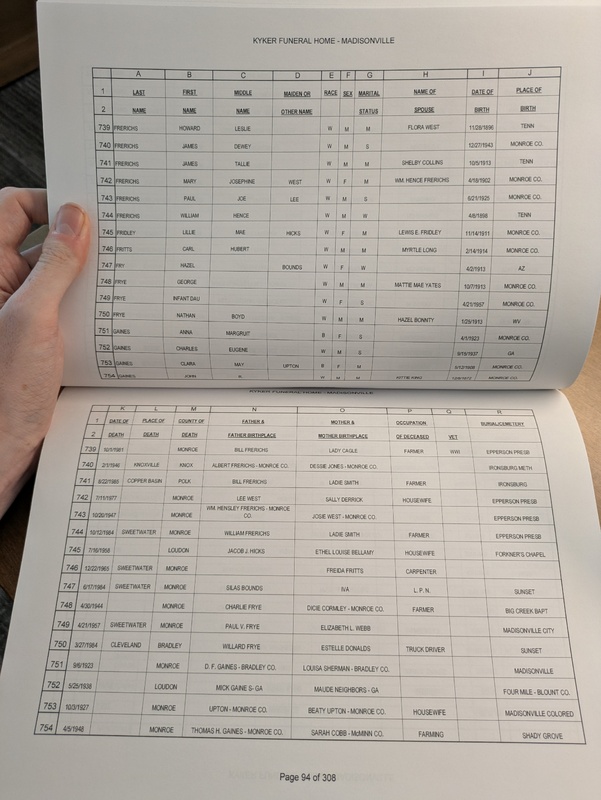
An Example Page from the Original Kyker Funeral Home of Madisonville 523 North College Street Madisonville, Tennessee Death Index 1922-2000. 

Access and Adoption Digital Map Methodology 

While the overall project shifted towards a more robust and interactive digital exhibit, a secondary goal of this project was to create a proof of concept for the origin funeral home mapping project, so if I were to move on to a PhD and introduce more spatial analysis into my research, I could have a solid base to structure a multi-funeral home map on. 

The data used in the digital map has experienced multiple passes of filtering. The information originates from two sources: the burial records of Kyker Funeral Home of Madisonville and the death certificates authored by the Funeral Director and a medical certifier corresponding with each funeral they managed. From 2004-2005, as part of an effort to transcribe all the funeral home records of all the locations of Kyker funeral home for genealogical research, members of the McMinn County Historical Society and Archives compiled burial information from surviving burial records at Kyker and microfilmed death certificates, however, who microfilmed these records and where they were housed is not known at this time. These transcriptions produced the volume Kyker Funeral Home of Madisonville 523 North College Street Madisonville, Tennessee, Death Index 1922-2000.

The records from other Kyker Funeral Home locations, such as Sweetwater and Harrison, are stated to be incomplete. The authors of the Madisonville Death Index seem to indicate that the information present in the Madisonville records is complete. However, due to the incomplete nature of the other locations' records and the vague language used, I assume that there are missing entries in these burial records and thus it is not entirely representative of all burials conducted by the business between 1922 and 1929. 

A copy of the death index was kept at the Tennessee State Library and Archives in Nashville, Tennessee. On October 18th, I manually transcribed the data from the index into a Google Sheet, then saved the raw data as a Raw Data XLSX document. Below are the lists of the original data fields of the death index, as well as the data I recorded for this project.

Original Data from Funeral Home Index
  • Last Name
  • First Name
  • Middle Name
  • Maiden or Other Name
  • Race
  • Sex
  • Marital Status
  • Name of Spouse
  • Date of Birth
  • Place of Birth
  • Date of Death
  • Place of Death
  • County of Death
  • Father and Father Birthplace
  • Mother and Mother Birthplace
  • Occupation of Deceased
  • Veteran Status
  • Place of Burial or Cemetery
Data Recorded for Project
  • Page Number
  • Last Name
  • First Name
  • Middle Name
  • Other Name
  • Race
  • Sex
  • Marital Status
  • Birth Place
  • Date of Birth
  • Date of Death
  • Place of Death
  • Occupation
  • Burial/Cemetery

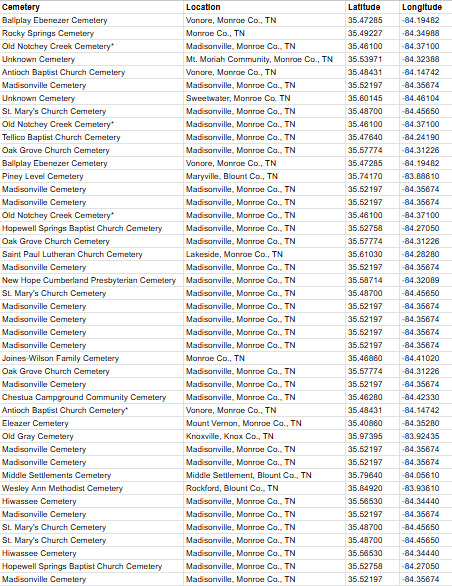
An Excerpt of the CSV File, Showing the Cemetery Names and Coordinates Gathered from Census Records and FindAGrave.com, 2025. Screenshot by Author.

From this transcription, I left out multiple data fields due to time constraints, as well as the data that would best serve the project, including the parent names and birthplace, veteran status, and the name of the spouse. In order to record all the data in one visit, I tried to limit the data to just the essential information regarding the person buried. This does erase those who actually buried the deceased from the record, limiting our ability to differentiate the wishes and financial means of the families from those they buried.  

I took the raw data and cleaned it, fixing errors as well as conducting research on the listed cemeteries of those listed in the records to identify the full cemetery name. With these full cemetery names, I utilized FindAGrave.com to find the coordinates of the cemetery so the software could accurately separate cemeteries located within the same city or county, preventing clumping of points. This produced the Cleaned Data XLSX document.

For the final CSV that would be imported into ArchGIS, I edited the data further so it was easier to read for a general audience. I added a dedicated "Title" field that copied the data in the "name" field, condensed the name fields into a single column, removed the page numbers, and separated the coordinates into separate latitude and longitude columns so ArchGIS could correctly read the data. This became the final ArchGIS-Ready CSV that ArchGIS would pull from to populate the map.

Originally, the embedded map was intended to be a Neatline map with the timeline feature enabled. I learned of Neatline through the course readings and our class discussions on data visualization and spatial histories, and I was drawn to the tool because of its visual emphasis and its seamless integration with Omeka Classic. Its ability to link points on the map directly to items in Omeka would have allowed for a more interactive map that was better interconnected with the digital exhibit. Additionally, Neatline’s ability to incorporate images and text more directly into the map could have created a more dynamic and narrative-focused interface as well. After researching Neatline, I decided to create the digital exhibit on Omeka Classic, due to Classic having more complete tools and support for Neatline Maps. As is discussed in Challenges and Limitations, I had to shift my focus towards ArcGIS for this proof of concept. 

I imported the CSV into ArcGIS, and created a web map with time enabled, so that the map populates points based on when they occurred over time. After minor tweaks in visuals, intervals for the timeline feature, and ensuring all points populate the map correctly, I created an Instant App based on the web map and embedded it directly into the "Access and Adoption" page.

Challenges and Limitations 

Following the creation of the Neatline-oriented CSV, I repeatedly ran into technical issues when attempting to import the CSV into Omeka Classic to mass-produce Omeka items. With help with the professor, I was able to finally import the items, however, they repeatedly failed to appear on Neatline. With recommendations from the professor, I switched towards creating an ArcGIS version of the map to finish the map by the end of the semester. With YouTube videos and online guides published by ArcGIS, I was successfully able to create the proof of concept, however, I believe this switch lost some of the interactivity as originally envisioned.  

The current map exists only as a proof of concept. While the data does suggest some general trends, it currently visualizes the burial records of just one funeral home. To make persuasive spatial arguments about East Tennesseans’ access to, and adoption of, funeral home services, the map would need data from multiple funeral homes in relation to one another, as well as multiple examples across the region—including Southeast, Central, Northeast, and Northwest East Tennessee. Transcribing funeral home records is an extremely slow process, and within the scope of a single semester I could only compile enough data from one provider.

Because of these limitations, the dataset used for this project also excludes several relevant fields, such as family and spouse information, that had to be cut to make mapping feasible within the course timeframe. With more time, I believe this map could effectively illustrate larger patterns in the region’s adoption of funeral home services, but such a project is beyond the scope of both the course and a master’s degree. Additionally, while point-based mapping works well for visualizing which cemeteries this single funeral home serviced, it becomes less effective at broader scales or with multiple businesses. For a larger, regional analysis, I will likely move toward a heatmap or density-based visualization, which would better represent patterns across many funeral homes.

Beyond the map, there are some limits to the narrative aspects of the exhibit. Some of the dates utilized in the "Development Timeline" are not confirmed to be fully accurate. Dates for establishment, such as for the Tennessee Funeral Directors Association and "The First Funeral Directors," are dependent entirely on when they first appear in Newspaper articles and advertisements and may not be fully accurate to their actual date of establishment. Finally, as previously mentioned, the preliminary nature of this research and the limited scope of the project forced me to rely on broader histories to craft regional histories. Although the project allowed me to make some regionally grounded arguments, some more revealing regional sources could not be explored within the limited scope of the project. As I continue to conduct research for my thesis, I intend to update this project to reflect my findings.

Bibliographies

Artisan Undertakers

Primary:

“Charles S. Douglas.” Knoxville Weekly Whig, June 28, 1851, 4. Newspapers.com.

Sam Wallace. Coffin, ca. 1920. Museum of Appalachia, Death, Funerals, and Remembrances exhibit.

Secondary:

Bettis, M., et al. “The Care of East Tennessee Dead.” In Glimpses of Southern Appalachian Folk Culture: Papers in Memory of Norbert F. Riedl, 108–121. Tennessee Anthropological Association, 1978.

Crissman, James K. Death and Dying in Central Appalachia: Changing Attitudes and Practices. Urbana: University of Illinois Press, 1994.

Foster, Gary S. & Lovekamp, William E., eds. Cemeteries and the Life of a Smoky Mountain Community. Cham: Palgrave Macmillan, 2019.

Howard, Joan Bailey. “Death and Burial in the Mountains: The Preparation and Burial of the Dead.” Appalachian Heritage 2, no. 1 (Winter 1974): 57–61.

Irwin, John Rice. Alex Stewart: Portrait of a Pioneer. Atglen, PA: Schiffer Craft Publishing, 1997.

Loughrige, Donna. “A Perspective on Death in Appalachia.” Appalachian Heritage 11, no. 1 (Winter 1983): 25–28.

McCusker, Kristine, Just Enough to Put Him Away Decent: Death Care, Life Extension, and the Making of a Healthier South, 1900–1955. Urbana: University of Illinois Press, 2023.

Phipps, William E. “Traditional Appalachian Funerals.” Appalachian Heritage 8, no. 4 (Fall 1980): 48–53.

Stansberry, Donna W. Burial Practices in Southern Appalachia. M.A. Thesis, East Tennessee State University, 2004.

Growing Industry

Primary:

“Furniture and Undertaking, Shephard and Renshaw Advertisement.” Knoxville Daily Whig, March 27, 1867, 1. Newspapers.com.

G. W. Franklin, Jr. Undertaking and Livery, Business Card. Undated. Eartha M.M. White Collection. University of North Florida, Thomas G. Carpenter Library Special Collections and Archives. UNF Digital Commons. https://digitalcommons.unf.edu/eartha_materials/912/.

“How a Story Grows.” Chattanooga Daily Times, April 7, 1912, 12. Newspapers.com.

"J. Long, Dealer in First-Class, Medium and Cheap Furniture, at Bottom Prices Advertisement.” Chattanooga Daily Times, February 18, 1884, 1. Newspapers.com.

“J. Long, Dealer in Furniture, Mattresses, &c Advertisement.” Chattanooga Daily Commercial, August 27, 1874, 4. Newspapers.com.

“J. Long Undertaker, Funeral Arrangements, Arterial Embalming Advertisements.” Chattanooga Daily Times, October 31, 1886, 6. Newspapers.com.

“Mann Mortician Advertisement.” The Knoxville Journal, July 24, 1927, 4. Newspapers.com.

Photograph of George Washington (G.W.) Franklin. Undated. John P. Franklin Funeral Home.

Photograph of G. W. Franklin Funeral Home. 1890s. Bessie Smith Cultural Center.

“Shephard, Mann, and Johnson, Undertakers and Embalmers Advertisement.” The Daily Chronicle, September 10, 1884, 4. Newspapers.com.

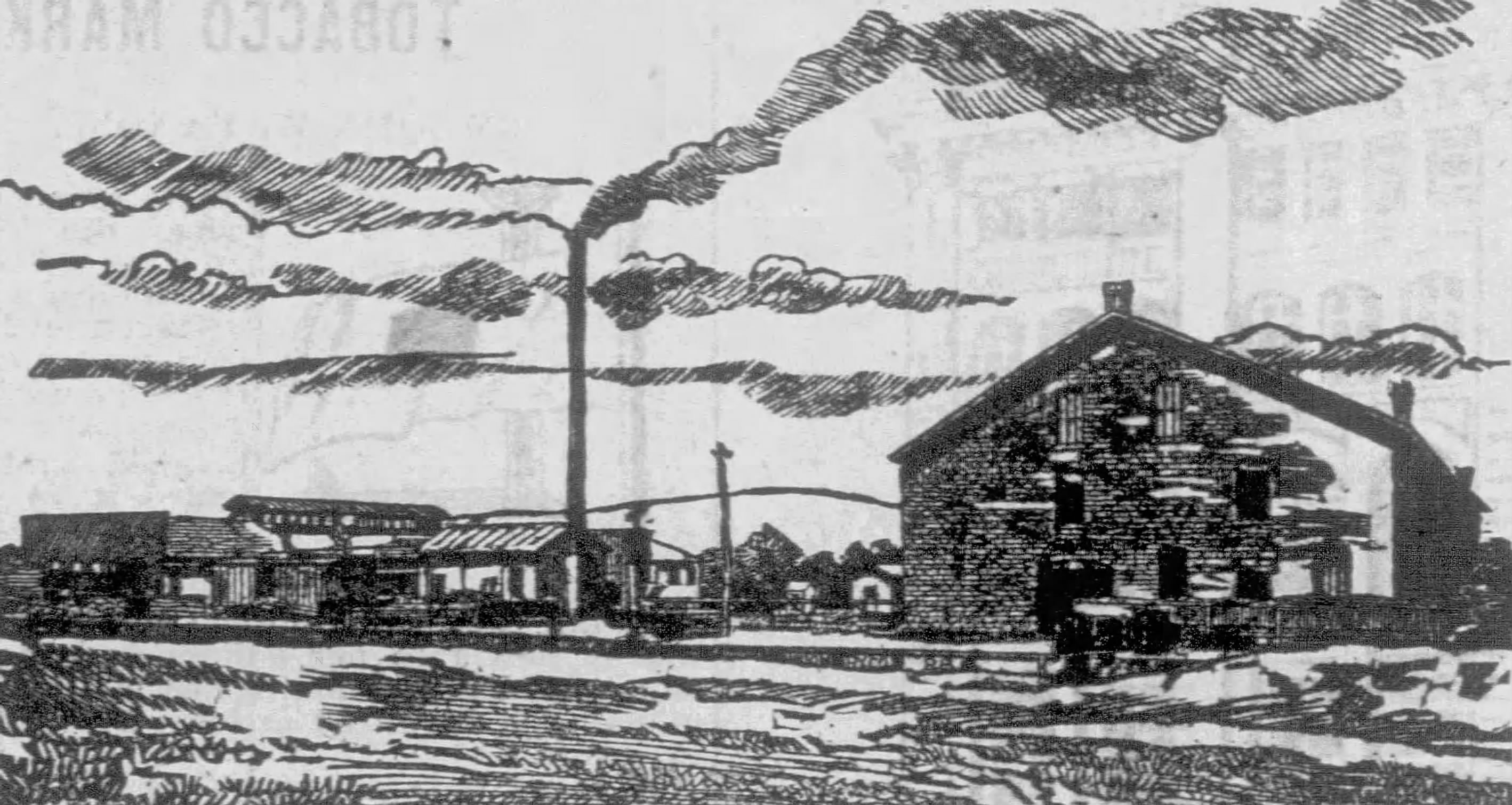
Sketch of the Chattanooga Coffin Company Factory. Chattanooga Daily Times, December 8, 1892, 32. Newspapers.com.

Secondary:

Bettis, M., et al. “The Care of East Tennessee Dead.” In Glimpses of Southern Appalachian Folk Culture: Papers in Memory of Norbert F. Riedl, 108–121. Tennessee Anthropological Association, 1978.

Crissman, James K. Death and Dying in Central Appalachia: Changing Attitudes and Practices. Urbana: University of Illinois Press, 1994.

Gardner, Leigh Ann. To Care for the Sick and Bury the Dead: African American Lodges and Cemeteries in Tennessee. Nashville: Vanderbilt University Press, 2022.

Hacker-Norton, Debi, and Michael Trinkley. Remember Man Thou Art Dust: Coffin Hardware of the Early Twentieth Century. Research Series 2. Columbia, SC: Chicora Foundation, Inc., 1984.

Loughrige, Donna. “A Perspective on Death in Appalachia.” Appalachian Heritage 11, no. 1 (Winter 1983): 25–28.

Stansberry, Donna W. Burial Practices in Southern Appalachia. M.A. Thesis, East Tennessee State University, 2004.

McCusker, Kristine, Just Enough to Put Him Away Decent: Death Care, Life Extension, and the Making of a Healthier South, 1900–1955. Urbana: University of Illinois Press, 2023.

Obermiller, Phillip J., and Ray Rappold. “Bury Me Under a Sidewalk: The Appalachian Way of Death in the Cities.” Then and Now: The Appalachian Magazine 7, no. 2 (1990): 28–29.

Wilson, Charles R. “The Southern Funeral Director: Managing Death in the New South.” The Georgia Historical Quarterly 67, no. 1 (1983): 49–69.

Development Timeline

Primary:

The Southern Funeral Director. Atlanta, GA, vols. 19–21 (July 1928–December 1929). Accessed via HathiTrust Digital Library.

“Bodies Embalmed.” Chattanooga Daily Gazette, October 20, 1864, 3. Newspapers.com.

“Mann & Johnson.” The Daily Chronicle, April 9, 1884, 4. Newspapers.com.

Sketch of the Chattanooga Coffin Company Factory. Chattanooga Daily Times, December 8, 1892, 32. Newspapers.com.

Dorman, Travis. “How Jarnigan & Son Survived Urban Removal to Become Knoxville's Oldest Black-Owned Business.” Knoxville News Sentinel, February 10, 2021. https://www.knoxnews.com/story/news/local/2021/02/11/how-jarnigan-son-became-knoxvilles-oldest-black-owned-business/6678765002/.

“Funeral Directors’ Association.” The Nashville Banner, May 8, 1888, 2. Newspapers.com.

“Colored Funeral Directors Meet.” The Nashville Banner, March 28, 1931, 9. Newspapers.com.

Secondary:

Crissman, James K. Death and Dying in Central Appalachia: Changing Attitudes and Practices. Urbana: University of Illinois Press, 1994.

Gardner, Leigh Ann. To Care for the Sick and Bury the Dead: African American Lodges and Cemeteries in Tennessee. Nashville: Vanderbilt University Press, 2022.

McCusker, Kristine, Just Enough to Put Him Away Decent: Death Care, Life Extension, and the Making of a Healthier South, 1900–1955. Urbana: University of Illinois Press, 2023.

Obermiller, Phillip J., and Ray Rappold. “Bury Me Under a Sidewalk: The Appalachian Way of Death in the Cities.” Then and Now: The Appalachian Magazine 7, no. 2 (1990): 28–29.

Stansberry, Donna W. Burial Practices in Southern Appalachia. M.A. Thesis, East Tennessee State University, 2004.

Wilson, Charles R. “The Southern Funeral Director: Managing Death in the New South.” The Georgia Historical Quarterly 67, no. 1 (1983): 49–69.
New Goods and Services

Primary:

The Southern Funeral Director. Atlanta, GA, vols. 19–21 (July 1928–December 1929). Accessed via HathiTrust Digital Library.

The Sunnyside. New York: The Sunnyside, 1900, 1926–1928. Issuu, Inc., Palo Alto, CA.

Secondary:

Church, R. A., and Barbara M. D. Smith. “Competition and Monopoly in the Coffin Furniture Industry, 1870–1915.” The Economic History Review 19, no. 3 (1966): 621–641.

Hacker-Norton, Debi, and Michael Trinkley. Remember Man Thou Art Dust: Coffin Hardware of the Early Twentieth Century. Research Series 2. Columbia, SC: Chicora Foundation, Inc., 1984.

McCusker, Kristine, Just Enough to Put Him Away Decent: Death Care, Life Extension, and the Making of a Healthier South, 1900–1955. Urbana: University of Illinois Press, 2023.

Obermiller, Phillip J., and Ray Rappold. “Bury Me Under a Sidewalk: The Appalachian Way of Death in the Cities.” Then and Now: The Appalachian Magazine 7, no. 2 (1990): 28–29.

Snyder, Ellen Marie. “At Rest: Victorian Death Furniture.” In Perspectives on American Furniture, edited by Gerald W. R. Ward, 241–272. New York: W. W. Norton & Co., 1988.

Tharp, Brent W. “Preserving Their Form and Features: The Commodification of Coffins in the American Understanding of Death.” In Commodifying Everything: Relationships of the Market, edited by Susan Strasser, 213–234. New York: Routledge, 2003.

Wilson, Charles R. “The Southern Funeral Director: Managing Death in the New South.” The Georgia Historical Quarterly 67, no. 1 (1983): 49–69.
Access and Adoption

Primary:

“Exterior Photograph of Stetzer Funeral Home of Hamblen County, Tennessee.” Morristown Gazette Mail, November 5, 1959, 8. Newspapers.com.

J. G. D’Armond Funeral Home Records, 1908–1939. Tennessee State Library and Archives.

Kyker Funeral Home of Madisonville, Tennessee Death Index, 1922–2000. McMinn Historical Society. Tennessee State Library and Archives, 2005?

Secondary:

Gardner, Leigh Ann. To Care for the Sick and Bury the Dead: African American Lodges and Cemeteries in Tennessee. Nashville: Vanderbilt University Press, 2022.

Hacker-Norton, Debi, and Michael Trinkley. Remember Man Thou Art Dust: Coffin Hardware of the Early Twentieth Century. Research Series 2. Columbia, SC: Chicora Foundation, Inc., 1984.

McCusker, Kristine, Just Enough to Put Him Away Decent: Death Care, Life Extension, and the Making of a Healthier South, 1900–1955. Urbana: University of Illinois Press, 2023.

Wilson, Charles R. “The Southern Funeral Director: Managing Death in the New South.” The Georgia Historical Quarterly 67, no. 1 (1983): 49–69.